Showing posts with label American Power. Show all posts
Showing posts with label American Power. Show all posts
Sunday, December 4, 2011
24 Hours on an Aircraft Carrier — USS Carl Vinson
This is so cool, via Theo Spark: The Carl Vinson's Wikipedia page is here. And at ESPN, "Producer chronicles a typical 24 hours aboard the USS Carl Vinson."

Who Killed Horatio Alger?
From Luigi Zingales, at City Journal:
RELATED: I dealt with some similar issues here: "Decline of American Exceptionalism?"
The title character of Horatio Alger’s 1867 novel Ragged Dick is an illiterate New York bootblack who, bolstered by his optimism, honesty, industriousness, and desire to “grow up ’spectable,” raises himself into the middle class. Alger’s novels are frequently misunderstood as mere rags-to-riches tales. In fact, they recount their protagonists’ journeys from rags to respectability, celebrating American capitalism and suggesting that the American dream is within everyone’s reach. The novels were idealized, of course; even in America, virtue alone never guaranteed success, and American capitalism during Alger’s time was far from perfect. Nevertheless, the stories were close enough to the truth that they became bestsellers, while America became known as a land of opportunity—a place whose capitalist system benefited the hardworking and the virtuous. In a word, it was a meritocracy.Continue reading.
To this day, Americans are unusually supportive of meritocracy, and their support goes a long way toward explaining their embrace of American-style capitalism. According to one recent study, just 40 percent of Americans attribute higher incomes primarily to luck rather than hard work—compared with 54 percent of Germans, 66 percent of Danes, and 75 percent of Brazilians. But perception cannot survive for long when it is distant from reality, and recent trends seem to indicate that America is drifting away from its meritocratic ideals. If the drifting continues, the result could be a breakdown of popular support for free markets and the demise of America’s unique version of capitalism.
RELATED: I dealt with some similar issues here: "Decline of American Exceptionalism?"
Sunday, November 20, 2011
Decline of American Exceptionalism?
Charles Blow, at the New York Times, draws the wrong conclusion from the recent report at Pew Research indicating that less than a majority of Americans (49 percent) agreed with the statement that "our people are not perfect, but our culture is superior to others." See, "Decline of American Exceptionalism":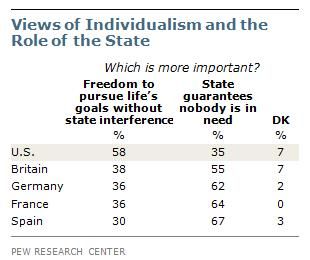 Via Astute Bloggers, "PEW POLL REVEALS CORE PROBLEM AFFLICTING THE WEST: MOST EUROPEANS NOW FAVOR A NANNY STATE."
Even if you put aside the somewhat loaded terminology of cultural superiority, Americans simply don’t seem to feel very positive about America at the moment....Blow's understanding of exceptionalism is not based in history, values, nor institutions. His view is in the things we do (like work hard to expand government and "invest" in the future) not what we stand for. He's a classic progressive that sees higher taxes and spending (for "infrastructure") as the means to buffing up that "City on the Hill" image. But Blow's meaning misconstrue's John Winthrop's famous sermon, where he evoked the Christian metaphor that the United States was a light unto the world. But not only that. Looking back over at that Pew study we see this data at the table embedded below. Part of our exceptionalism is the belief in individualism, that the individual is basis of the good society and that the political order is established to preserve individual liberties. Progressives continually downplay individualism in American exceptionalism because it conflicts with their big-government nanny-statism. Charles Blow wants to continue building the big nanny state. When he says we must "invest" in all those things he's really saying that we must spend more on the traditional progressive programs that are bankrupting the nation. But the way to invest again is the restore economic liberty and unleash individual potential and entrepreneurialism. To do otherwise will do nothing but turn us into a dependency society like all of the truly crumbling European states highlighted by the Pew data:
We are settling into a dangerous national pessimism. We must answer the big questions. Was our nation’s greatness about having God or having grit? Is exceptionalism an anointing or an ethos? If the answers are grit and ethos, then we must work to recapture them. We must work our way out of these doldrums. We must learn our way out. We must innovate our way out.
We have to stop snuggling up to nostalgia, acknowledge that we have allowed a mighty country to be brought low and set a course to restitution. And that course is through hard work and tough choices. You choose greatness; it doesn’t choose you.
And that means that we must invest in our future. We must invest in our crumbling infrastructure. We must invest in the industries of the future. We must invest in a generation of foundering and forgotten children. We must invest in education. Cut-and-grow is ruinous mythology.
We must look out at the world with clear eyes and sober minds and do the difficult work as we’ve done time and time again. That’s how a city shines upon a hill.
Subscribe to:
Posts (Atom)