Showing posts with label Supreme Court. Show all posts

Tuesday, November 8, 2011

Susan Seven-Sky v. Holder

The D.C. Circuit has issued a ruling upholding the constitutionality of the individual mandate of the Affordable Care Act (the federal version of Romneycare). The opinions are here. Two interesting features of the majority opinion: (1) it was authored by Judge Lawrence H. Silberman, a very conservative jurist appointed by President Reagan; and (2) it relies heavily on the precedential value of that old New-Deal chestnut, Wickard v. Filburn, 317 US 111 (1942), in which the Court ruled that the federal government could regulate, under the Commerce Clause, wheat grown by a farmer for his own consumption.

Perhaps I'm overly cynical, but I wonder whether Judge Silberman, who expressly notes in his opinion that the Supreme Court will ultimately decide on the constitutionality of the individual mandate, was merely teeing up Wickard v. Filburn, hoping that the Supreme Court might strike it down along with the individual mandate. The Roberts Court certainly has not been hesitant to overrule well-established Supreme Court precedents extending back many decades. See Citizens United.

Sunday, February 20, 2011

Judge Posner on Gun Control and Federalism

Over at the Becker-Posner blog (here), Judge Posner notes the
unwisdom of the Supreme Court’s recent decisions that have created—on the basis of a tendentious interpretation of the drafting history of the Second Amendment and an intellectually untenable (as it seems to me) belief in “originalist” interpretations of the Constitution—a constitutional right to possess guns for personal self-defense. The result is to impose a significant degree of nationwide uniformity on a problem that is not uniform throughout the nation. The case for private gun ownership is much stronger in largely rural states, such as Arizona—states in which there is a deeply entrenched and historically understandable gun culture and a rationally greater lawful demand for private gun ownership than in the suburban areas of the densely populated midwestern, northeastern, and mid-Atlantic states—than it is in big cities with high crime rates—cities that have long had very strict gun laws many of which may now be ruled unconstitutional. 
I find appealing Judge Posner's argument  that different states should be allowed to have different levels of gun control based on their respective histories, norms, and demographics (e.g., rural v. urban populations). The problem, of course, is that, even if everyone concedes the bankruptcy of "originalism," it would be very difficult for the Supreme Court (or any court) to apply constitutional mandates and limitations non-uniformly from one state to another.
Thursday, January 20, 2011

On This Date

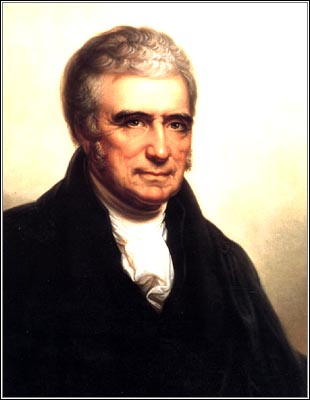
On January 20, 1801, John Marshall is appointed Chief Justice of the US Supreme Court, arguably the most momentous decision in the history of US constitutional interpretation.

Thursday, November 18, 2010

Supreme Court Opinions Are Growing Longer, Less Clear, and More Boring

A terrific piece of reporting by Adam Liptak in today's New York Times (here) supports an argument that I have long been making (see, e.g., here and here) that Supreme Court opinions are out of control. Here's one interesting tidbit from the article: In the 1950s, the median length of Supreme Court opinions was 2000 words. The Court's ruling in Brown v. Board of Education - a judicial landmark if ever there was one - was all of 4000 words. Today, by contrast, hardly any Supreme Court opinions manage to come in under 10,000 words; and it is not at all uncommon to find opinions in the 40,000-word range, which approximates a 300-page book.

This might be acceptable if the opinions were well crafted and engaging to read, but they never are. As Liptak points out, Supreme Court opinions are pastiches of draft opinions by clerks, plagiarized sections of briefs from the parties, topped off with a few apercus by the Justices themselves. They are stylistically inconsistent and often border on incoherence, which needless to say undermines their pedagogical and wider social purpose. What we need are opinions that are clear, to the point, and written with a bit of flair. What we tend to get are plodding tomes.